
Your next stockout is already scheduled.
Not “might happen.” Scheduled. It was decided weeks ago by an order-by date nobody was watching. We model your catalog once, then run a weekly planning cycle with you or for you, so you never guess a reorder again.
If your suppliers quote lead times of 30 to 120 days, whether you’re in stock on day 90 is being decided in weeks like this one.
Real findings, from real engagements.
Four anonymized engagements. Every number traces to a documented catch, not a claim written for this page.
The full record →Run your own number.
Two costs, and you’re paying both today. Move the sliders. These are directional retail-analytics estimates, not claims about your business, so check them against your own last stockout: the SKU, the days dark, the rank you had to buy back.
Reorder math, ETA chasing, PO and deposit approval. Most founders at this stage spend more than they count.
4 to 8 percent of revenue lost to stockouts a year, on a brand running real inventory without a disciplined weekly watch. Core costs $15,000 a year.
312 hours a year, valued at $75 to $125 of your own time.
You’re already paying for supply chain management. You’re just paying it to yourself, at midnight, in the currency you can least afford.
It’s 11pm, and you’re still the freight desk.
If you sell physical products with real supplier lead times, the decisions that make or break your cash are made weeks before the symptoms show. Four ways it goes wrong:
Stockouts that destroy momentum
A stockout costs you more than a day of sales. On Amazon it sinks your rank and the organic momentum you spent months building. On Shopify and retail it costs you the reorder and, often, the customer. Recovery takes weeks.
Cash asleep in the wrong inventory
Long lead times force you to order months ahead. Order too much and your cash is locked in a warehouse, aging toward a storage surcharge tier nobody is watching. Order too little and you’re back to stockouts.
Three numbers that disagree
Amazon says one thing. Your 3PL says another. Your supplier is holding stock neither of them knows about. You make reorder decisions on top of all three, and somewhere in the gap is a stockout or a pile of dead cash.
The founder is the planner
You’re the CEO, the inventory planner, and the freight coordinator. You have chased a forwarder for an ETA at 11pm personally, more than once, because nobody chased it during business hours.
Red is when it hurts. Cyan is when it was decided.
None of them failed because the math was hard.
You’ve probably attacked this three ways already. Each one failed the same way, and it wasn’t intelligence that was missing.
The spreadsheet
Held the math but not the discipline. It was right the day it was built and decayed from there, because nobody is paid to keep it true.
The software
Still on your card statement. It will happily recommend a reorder against a stock number that’s wrong, because it doesn’t know your 3PL miscounted. Numbers, no judgment.
The hire
Ramped for months, held the system in their head, and left with it. Or never ramped at all, and you spent six months finding out.
What all three were missing isn’t intelligence. It’s ownership. Someone responsible, every single week, for the plan being true, with a written system that survives them. That is the product. Everything else is how.
How this compares to the tools, by name →Three layers, then one cadence.
We model your catalog once, properly. Then the weekly rhythm keeps it true.
Stop the bleed
Before optimizing anything, we find the money already leaking. The Sunset Tab flags dead stock and surcharge exposure per SKU with a reason attached. The Found-Money Sprint sweeps unreconciled shipments, overstock, and placement eligibility. The Reconciliation Layer makes your platform, your 3PL, and your supplier agree, with the discrepancies named.
Build the model
The Master Sheet System: one combined inventory and demand view across every node. The PO Tracker, so an order’s status is a field and not a conversation. The Forecast Engine, sizing reorder points off real velocity by SKU and channel. The Lead-Time Pipeline Model, a 23-stage map of how long things actually take, so your Q4 and Chinese New Year order-by dates fall out automatically.
Leave it behind
The Nine SOPs, installed and trained, so the system survives any one person stepping back. Including us.
The run
The plan lands before your call. Thirty minutes with your account lead, walking the decisions and not the data. The watch happens in between: order-by dates, ETAs, velocity spikes, and the reconciliation that keeps all of it honest.
Thirty minutes on Tuesday. That’s the whole ask.
One structured handover at the start, one sign-off walkthrough at the end of the build. After that, the calendar cost is a single call a week.
One column of seven. That is the entire calendar cost after the build, and it does not grow with your catalog.
Monday
The plan is already in your inbox. Every SKU that needs an order, with the quantity, the supplier, and the order-by date. Every transfer worth making. Every risk flag, ranked, each with a reason.
Tuesday
Thirty minutes, one call. The senior lead walks you through the decisions. You say yes, no, or “not that one, here’s why.” That context goes into the system so it’s sharper next week.
The rest of the week
You go run your business. The order-by dates are watched. The ETAs are chased by someone else. When a SKU accelerates past twice its baseline, the flag reaches you while it’s still cheap to fix.
The number that used to live in your head at 2am now lives in a system you can audit.
This is the file, not a mockup of one.
Every Monday you get a workbook, not a dashboard login. Same tabs, same thresholds, every week. The column that matters is Next PO placement: the date a replenishment decision has to be made, worked backwards from when you run out.
Next PO placement = [@[OOS date]] − [@[Total LT]] // the date the decision has to be made| A | B | C | D | E | F | G | H | I | |
|---|---|---|---|---|---|---|---|---|---|
| 1 | Amazon SKU | DOC AVL | DOC FBA | DOC 3PL | OOS date | Next PO placement | Qty to order | Forecast confidence | Total LT |
| 2 | EM-SCT-02 | 11 | 11 | 149 | 14 Aug | TODAY | 640 | HIGH · downside aligned | 45 |
| 3 | CK-PAN-12 | 64 | 38 | 88 | 05 Oct | 06 Aug | 2,400 | HIGH · upside aligned | 60 |
| 4 | PT-BED-03 | 62 | 41 | 74 | 03 Oct | 11 Aug | 1,150 | MEDIUM · demand slowdown | 55 |
| 5 | CK-DUO-08 | 96 | 61 | 112 | 06 Nov | 19 Aug | 1,200 | HIGH · downside aligned | 75 |
| 6 | GR-MAT-07 | 115 | 78 | 141 | 25 Nov | 02 Sep | — | LOW · structural mismatch | 90 |
| 7 | — | — | — | — | — | — | — | — |
Lead time is a path, not a number.
Every leg of a chain has its own clock. The one that sets your order-by date is the longest run of them end to end, which is almost never the one people add up. Here is a whole catalog drawn out, with that path picked out in it.
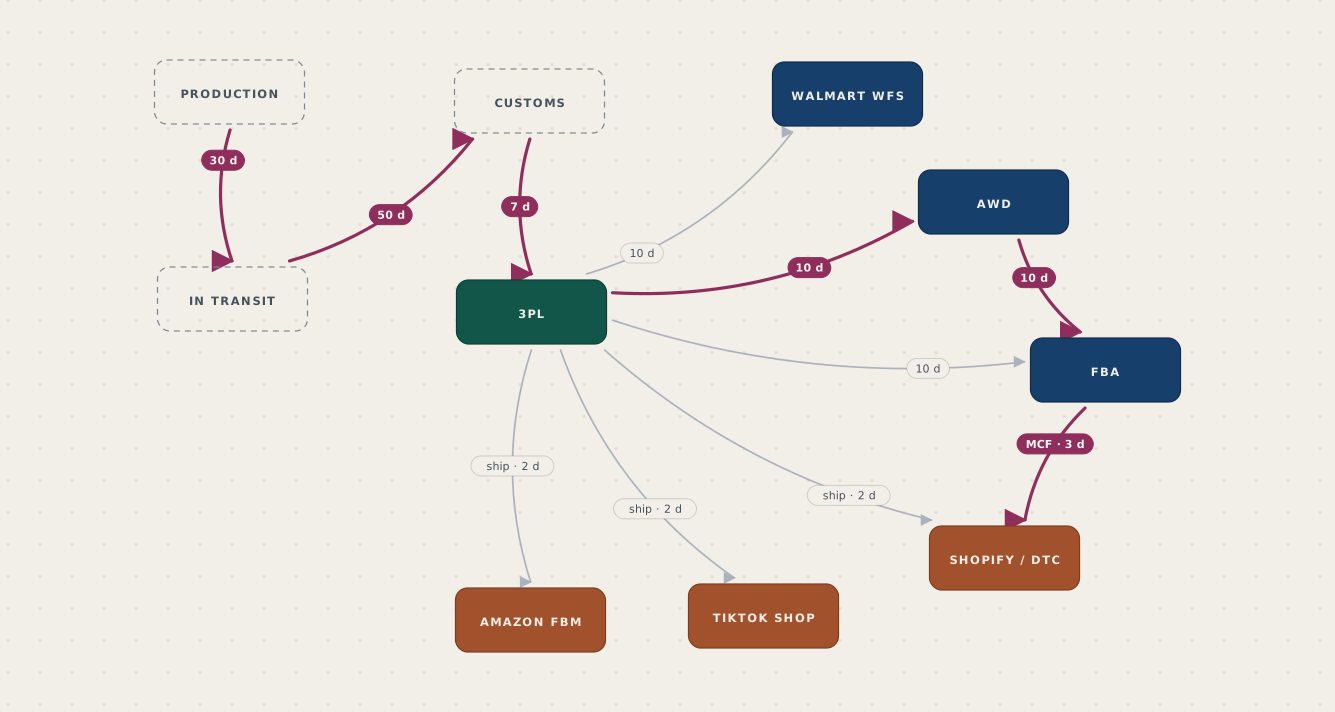
Lead time is the longest path, not the sum: two branches out of one 3PL run at the same time. This chain totals 110 days, and the last three of them are an MCF order shipping out of the same FBA units the Amazon side is counting on.
Illustrative SKU and figures. The columns, the thresholds and the redacted row are exactly what a real file looks like.
Draw your own supply chain map →If you hold real inventory, this is for you. Amazon or not.
Our deepest bench is Amazon, and the name says so. But the engine plans against lead times and nodes, not against a marketplace. The brands we run are rarely on one channel, and none of the modelling changes when you add another.
Four inputs, one reorder point. Adding a channel adds a column. The model that produces the date does not change.
Illustrative SKU and figures. The structure is the real one: velocity is tracked per channel and planned on the combined number, which is why the sheet carries an Amazon column and a TikTok Shop column side by side.
Marketplaces
Amazon FBA, FBM, AWD and multi-region. Walmart, TikTok Shop, eBay, Etsy. The Amazon-specific work, placement, badge eligibility, reimbursements, is depth we bring, not a boundary we stop at.
Your own store
Shopify, WooCommerce, BigCommerce, headless. Direct-to-consumer stock is planned in the same sheet as everything else, against the same lead times and the same reorder points.
Wholesale and retail
Retail POs, distributor and B2B orders, and stock held at your own warehouse or a 3PL. If it consumes units and has a lead time, it belongs in the model.
The one thing that does matter: real inventory with real supplier lead times, roughly 30 to 120 days. That’s the constraint the engine is built around. Channel mix is just columns.
Someone else already vouched.
Nothing written in the first person settles whether we’ll be careful with your money. A platform-verified record does. Upwork computes these numbers, we don’t, and nothing here is rounded up.
“He came in fast, asked the right questions upfront, and the model he built was clean and actually usable by the team, not just impressive to look at. I first worked with him about a year ago on a similar scope and had a good experience. This confirmed it wasn’t a fluke. If you’re looking for someone who understands the operational side of inventory and purchasing, not just the spreadsheet mechanics, he’s worth the conversation.”
The record, in rows
Upwork computes every number here. Nothing is rounded up, and no client is named until they clear it themselves, which is also why the reviews carry no names.
What we will never show you: a guarantee of zero stockouts, a forecast-accuracy percentage, or a promise that any of this runs fully automated with nobody watching. Firms that promise those things are lying to you, and the fastest way to lose your trust in month three is to buy it with a lie in month one.
One build. Then two ways to run it.
Fixed monthly pricing, quoted upfront. No hourly billing, and no discovering the scope in month three.
We model your catalog once, properly: every node, every lead time, every reorder point, and the nine SOPs that keep it running. Thirty days. The workbook is yours.
Half of it comes back as credit at month six. Prepay a year and all of it does.
- The weekly plan, before your call
- The 30-minute call with your senior lead
- Risk flags and velocity-spike watch between calls
- ETA discipline: committed versus actual, chased on a cadence
- Quarterly supplier scorecards and the month-end valuation
- You place the POs and run the transfers
- Everything in Core
- We place the approved POs in your name
- We run the transfers and follow them to check-in
- Suppliers and forwarders chased live, twice a week
- Peak-season PO placement and air-versus-ocean bridges
Same plan either way. The difference is whose week it consumes.
See everything the build installs →The Found-Money Guarantee.
You judge it, with us, at the walkthrough, with the evidence on screen.
If the build doesn’t surface at least one material finding, an unreconciled shipment, a misstated stock position, a wrong lead time or MOQ in active use, an overstock or surcharge exposure, the build fee comes back as service credit toward Core or Partner.
Capped at fees paid. Service credit, never cash.
Here’s why we can offer it: every documented engagement we have run has surfaced something material in the modeling. You’ve just read six of them. The guarantee isn’t a bet against you, it’s the working record, formalized.
Then don’t buy one.
If you’re under 50 SKUs, or you don’t hold real inventory with real lead times yet, a contract will do less for you than your own hands and a decent sheet. Ask us and we’ll point you at a free tool instead. We’d rather say that now than three months in.
Ask us what to use instead →Thirty minutes, then you decide.
Thirty minutes on a free call. You almost certainly know which SKUs are tight already. The harder part is the order-by date sitting behind them, the cash that has quietly stopped moving, and where your three systems disagree. That’s the conversation.